

Calories to Grams Converter (kcal to grams)

Converting Your Energy Needs (kcal) into Macronutrients (grams of protein, carbohydrate, fat).
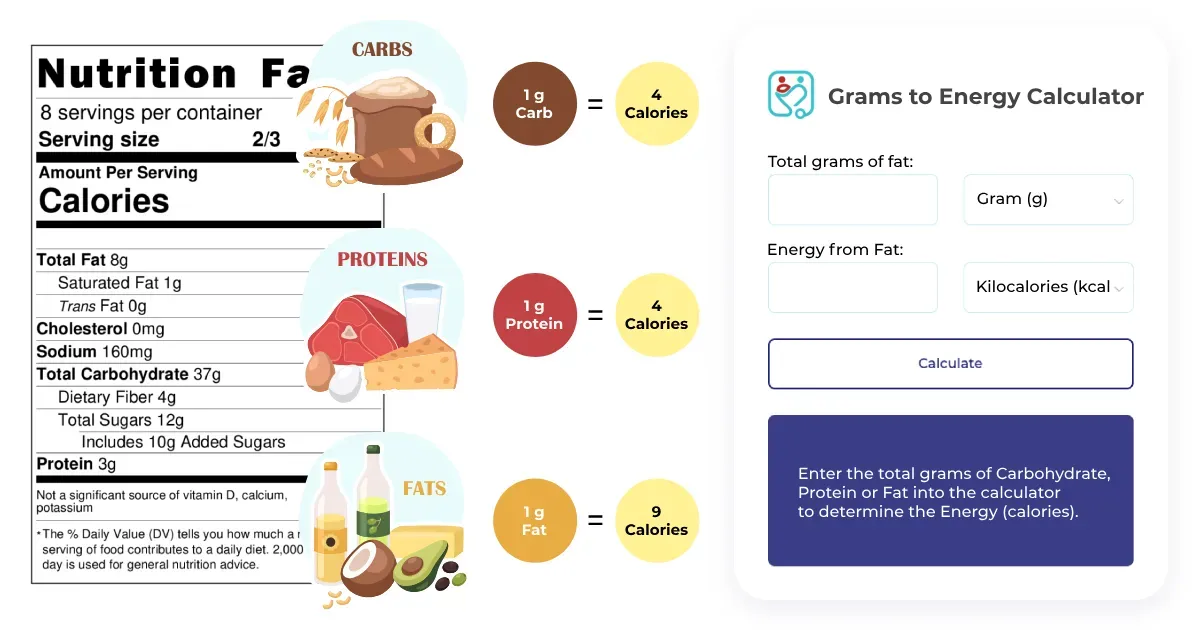
Grams to Energy Calculator

Calories to Grams Converter: From Your Energy Needs To Macronutrients

We've all been there: you've calculated your daily calorie needs (kcal), but now what? Knowing your energy needs is just the first step. To truly optimize your diet and achieve your fitness goals, you need to translate those calories into actionable targets for protein, fats, carbohydrates (grams).

Example calculation: let's assume your daily calorie goal is 2000 calories and you set specific ratios for each macronutrient (30% protein - 30% fat - 40% carbohydrates).

  • Calculate daily calories for protein intake: 2000 calories * 0.30 = 600 calories and convert it to grams: 600 calories / 4 = 150 grams of protein.
  • Calculate daily calories for fat intake: 2000 calories * 0.30 = 600 calories and convert it to grams: 600 calories / 9 = 66.67 grams of fat.
  • Calculate daily calories for carbohydrates intake: 2000 calories * 0.40 = 800 calories and convert it to grams: 800 calories / 4 = 200 grams of carbohydrates.

To simplify macro tracking, by entering the calorie target into this converter to determine how many grams of protein, carbs, and fat you should consume.

Macro Tracking & Food Logging: Unveiling Your Eating Patterns

While calorie counting can be a useful tool, it's important to remember that it's not the sole determinant of health. Prioritizing nutrient-dense foods is essential, regardless of their calorie content. Unlike calorie counting, macronutrient tracking focuses on the types of nutrients you consume, specifically proteins, carbohydrates, and fats, rather than just the total energy intake. These macronutrients play crucial roles in our bodies. They provide energy, support growth and repair, and maintain various bodily functions. Understanding and tracking these macronutrients can lead to more balanced and nutritious eating habits.

Balancing macronutrients is a personalized approach. By diligently analyzing your food log, you can gain valuable insights into your eating habits, identify areas for improvement, and create a more personalized and effective nutrition plan that supports your health and fitness goals. The ideal ratio depends on your goals and requires ongoing adjustments. Begin by establishing a baseline of your current macronutrient intake for a week or two. Implement small, gradual adjustments to your macro intake and observe the effects. Identifying long-term patterns and make lasting changes.