

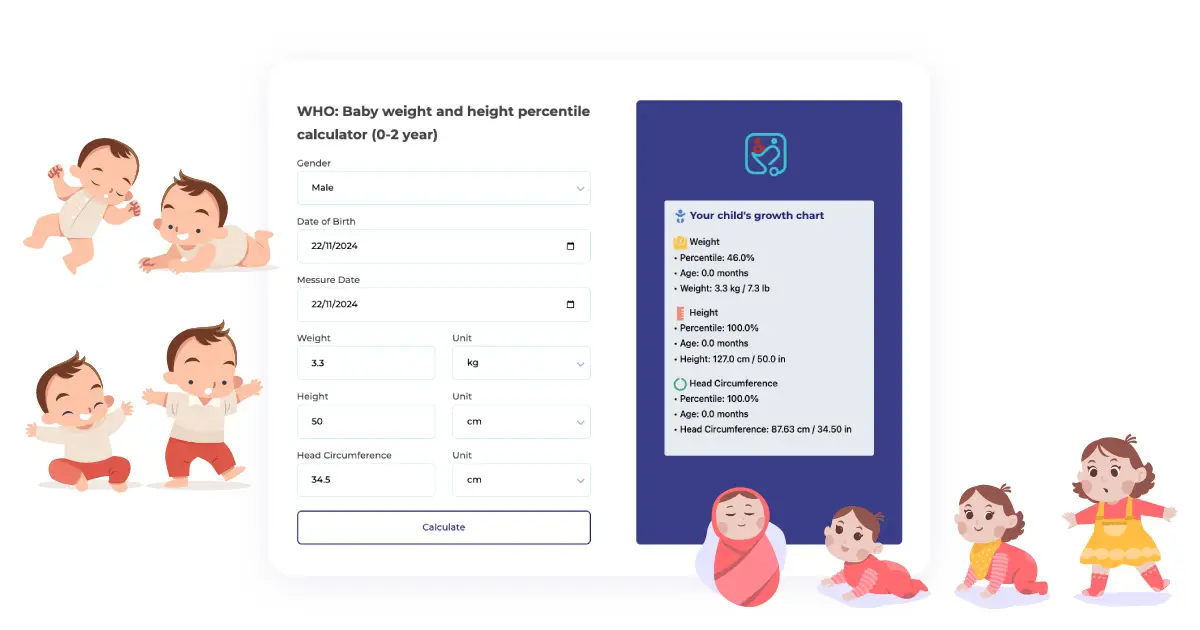
WHO: Baby weight and height percentile

This calculator shows how your baby's size compares with other boys or girls the same age. Just enter your baby's weight, height (aka length), and head circumference, and we'll calculate a percentile for each.

Growth chart: Baby weight and height percentile calculator

Baby Percentile Calculator (Age Birth to 2 Years)

World Health Organization (WHO) Child Growth Standards are recommended for monitoring the growth of U.S. children from birth through 2 years. This calculator shows how your baby's size compares with other boys or girls the same age. Just enter your baby's weight, height (length), and head circumference, and we'll calculate a percentile for each number.

How to Use a Baby Percentile Calculator?

  • Weight: use a calibrated baby scale.
  • Length: measure your baby while they're lying down, from head to heel.
  • Head Circumference: measure around the widest part of the head.

The calculator will generate percentile rankings for each measurement. A higher percentile indicates your baby is larger than average, while a lower percentile means they are smaller. A 50th percentile means your baby's measurement is average for their age. Similarly, if your baby is in the 75th percentile, that means that your baby is bigger than 75 children and smaller than only 25, compared with 100 children same age.

Is My Baby Too Big? Is My Baby Too Small?

A baby is considered too large if they are in the 90th percentile or higher for their gestational age. While a baby is considered underweight if they are in the 5th percentile or less.

This is a general understanding of percentile results on baby growth charts. However, it's important to consult with your pediatrician for an accurate interpretation of your baby's growth and providing personalized advice. Baby's growth is influenced by many factors, there are important considerations:

  • Individual variation: every baby grows at their own pace. Minor fluctuations in percentile rankings are often normal.
  • Growth pattern: your pediatrician will look at your baby's overall growth pattern over time, not just a single measurement.
  • Other factors: factors like genetics, nutrition, and overall health can influence a baby's growth.

Babies often experience periods of rapid and slow growth, causing them to cross percentile lines. This is a natural part of development. For instance, a larger newborn might initially gain weight more slowly than smaller babies. However, as children get older, their growth patterns become more consistent. If you're worried about your baby's growth, don't hesitate to talk to your pediatrician. They can assess your baby's growth, review your feeding plan, and offer helpful tips to ensure their healthy development.

Reference: The WHO Child Growth Standards